
What have nearly five decades of research taught us about Philippine mangroves? In a review of 658 studies published from 1979 to 2026, Dr. Severino G. Salmo III and colleagues found that mangrove biodiversity research was concentrated in a few provinces and focused mainly on economically important groups such as fishes, crabs, and mollusks. The review also traced a shift in the pressures on mangrove forests, from widespread fishpond conversion in the 1970s to urban development and coastal reclamation in later decades.
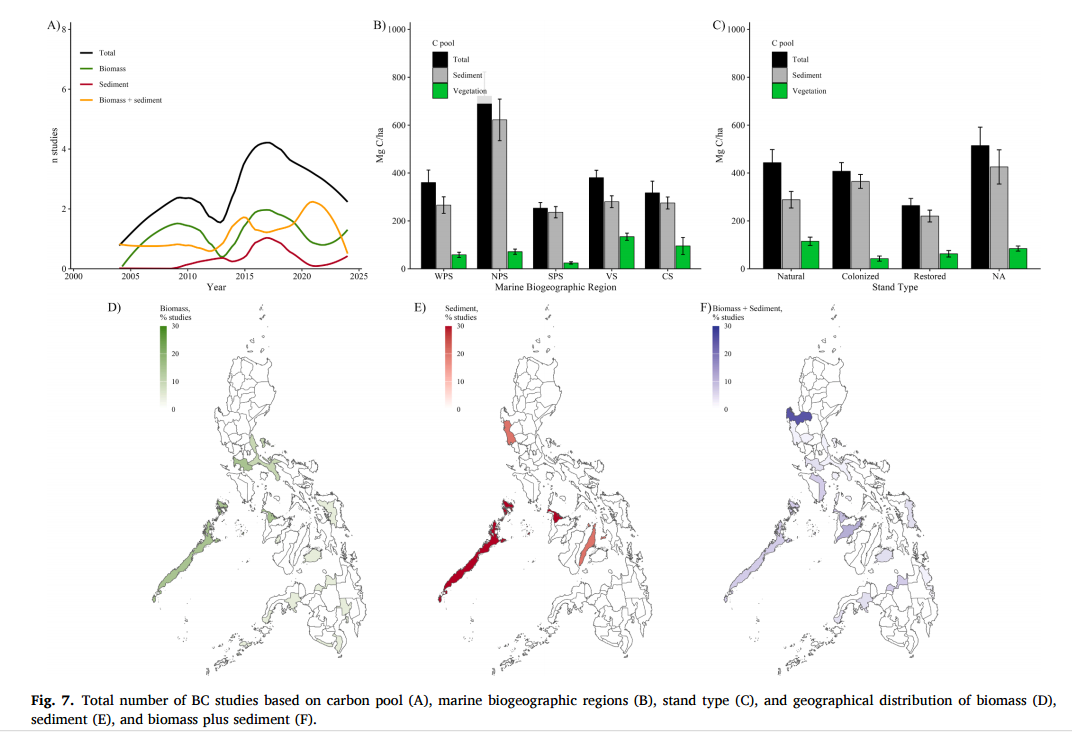
Across studies that measured carbon stocks, natural mangrove stands stored more carbon per hectare on average than restored stands. Protecting the remaining mangrove forests will be the primary management action, but it has to be complemented with an effective restoration program. The authors recommend tracking biodiversity and carbon stocks over time in intact, disturbed, and restored mangroves to see how they change and how much recovery takes place. These are immediate science-based parameters that will track the in/effectiveness of conservation and restoration programs.
The research foci should deliberately target “biodiversity” and “blue carbon” topics. But current studies are at least 50 % funded by foreign/international institutions. This is good – we are getting international support. But if we are serious in advancing Philippine research, we really have to be serious in funding/supporting Filipino researchers. We hope that in the next coming years, we will see an increase in the number of publications authored by Filipinos (and not just mere co-authors).
Read the full paper here: https://www.sciencedirect.com/science/article/abs/pii/S2352485526007917