
EVENT HIGHLIGHTS
The Fisheries Management Area (FMA) 6 Stakeholder Conference was successfully held on August 27–28, 2025, at Quest Plus Conference Center, Clark, Pampanga. The event convened representatives from government agencies, academic institutions, local government units (LGUs), and other key stakeholders in FMA 6. The conference served as a platform to present the results of the Mangroves BlueCAP study under the FishCoRe Project and to exchange knowledge and identify strategies for sustainable mangrove management and blue carbon readiness in FMA 6 through a stakeholder workshop.
Opening Session
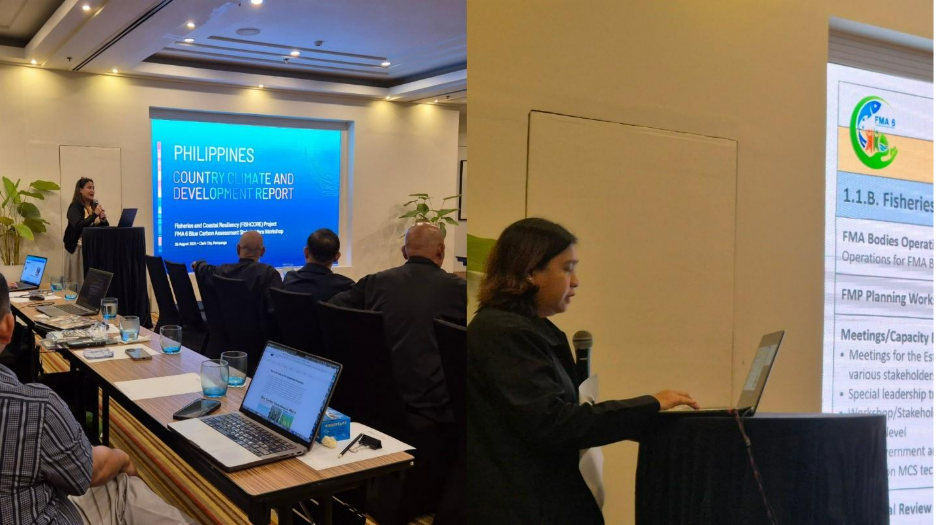
Mr. Neil Kenneth Catibog, BFAR Region 3 Division Chief, opened the conference, followed by an opening message from Ms. Agnes Chung Balota, Senior Environmental Specialist at the World Bank Office Manila, where she discussed the links between climate change and blue carbon in the Philippines. Ms. Arlyn Morales-Mendoza from BFAR Region 3 then provided an overview of the FISHCORE and PPCR projects. Followed by Ms. Precious Jacob, Blue Cap Research Associate, who introduced the ecological concept of “blue carbon” and an overview of the Mangroves BlueCAP study.
Technical Reports
- Mangrove Extent, Temporal Changes, and Carbon Sequestration Potential – Engr. Ainalyn Nerves, GIS Research Assistant, presented a spatial analysis of temporal changes in mangrove extent per province in FMA 6 from 2000 to 2020 through remote sensing. Majority of FMA 6 mangroves are classified as either “disturbed” or “restored” over the 20-year period. This underscores the importance of capacity building to train LGUs in mapping and documenting mangrove changes.
- Carbon Stock and Soil CO₂ Efflux of Select Mangrove Sites in Fisheries Management Area 6 – For. Sean Paul Manalo, Research Associate, reported the results of their field-based measurements of carbon stock and soil CO2 efflux rates across varying stand types in FMA 6. He highlighted that intact mangroves exhibited higher carbon stock and CO2 efflux compared to disturbed stands. Standardization of blue carbon quantification protocols in the country and establishment of permanent monitoring plots for regular carbon stock assessments is recommended.
- Mangrove Carbon Restoration Potential of Fisheries Management Area 6 – Engr. Cristan Dave Zablan, GIS Research Assistant, discussed the estimated mangrove carbon stock per province in FMA 6 and identified potential restoration sites through remote sensing. High restoration potential is evident for Pangasinan, both in terms of suitable areas and potential score. Additional data, particularly on the extent of AUU ponds, is needed to improve model accuracy.
- Synthesis of Research Results – Dr. Severino G. Salmo III, Project Leader, synthesized the presented studies and highlighted the findings’ relevance to the advancement of Blue Carbon Financing in the Philippines. He stressed the importance for LGUs to set clear targets for blue carbon permanence and additionality by 2030 and to establish mechanisms for tracking and reporting progress through an open-access platform.

Download presentation files here.
Stakeholder Workshop
The stakeholders engaged in a workshop designed to capture their insights on mangrove management and blue carbon readiness within their respective local contexts. The workshop followed the World Café approach, where participants were divided into four groups from different geographic areas and sectors. Each group rotated across four discussion tables focusing on the following topics:

- Main drivers for mangrove cover changes
- Major policies and institutions affecting mangrove management
- Good local practices in mangrove restoration and protection
- Blue carbon readiness
The groups then presented their ideas to the whole group. Workshop results can be requested from the project members.
Scientific Advisory Group Meeting
Dr. Salmo with Ms. Agnes and the FMA 6 Scientific Advisory Group (SAG) then held a meeting to discuss how the study’s findings can possibly advance blue carbon initiatives in the FMA. Some key highlights from the SAG meeting include:

- There is a need to capacitate SUCs in FMA 6. For them to engage, we must invest in training and technology transfer.
- The FISHCORE project can support SUC capacity building when SUCs partner with a beneficiary community. This can be implemented under FISHCORE’s Coastal Habitat Management and Rehabilitation Framework
During the meaeting, Dr. Salmo also presented the online data analytic platform (DAP) that the Blue Cap project created. The DAP is a comprehensive platform for tracking blue carbon data and potential in the Philippines.
Event Gallery







 Mangrove Ecology