
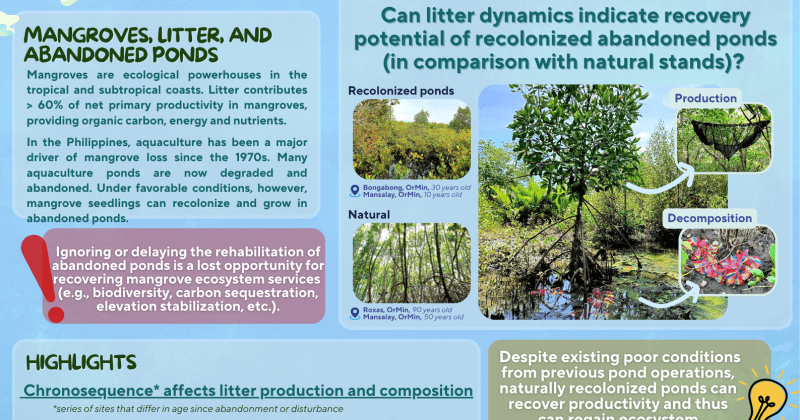

Mangrove ecosystems serve as nature-based solutions for climate change adaptation and mitigation. Many of the mangrove areas in the Philippines that were converted to aquaculture ponds in the 1990s are now abandoned and unproductive. Yet, mangrove seedlings can naturally recolonize and grow in these areas under favorable conditions. Our newly published study titled, “Exploring litter dynamics as indicator of forest recovery in mangrove-recolonized abandoned ponds,” explored the recovery potential of mangrove-recolonized abandoned ponds using litter dynamics as indicator. Rates of litter production and decay in mangrove-recolonized fishponds and natural stands in Oriental Mindoro, Philippines were compared. Results show that while rates of litter production in recolonized ponds are significantly lower (3.95 - 8.86 Mg/ha/year) than in intact, natural mangroves (9.10 – 12.40 Mg/ha/year), rates of litter decay are comparable (0.37 g/day). This indicates that despite existing poor conditions from previous pond operations, naturally recolonized ponds can recover productivity and thus can regain ecosystem functionality. Abandoned ponds should then be considered as priority sites for mangrove rehabilitation. Ignoring or delaying the rehabilitation of abandoned ponds is a lost opportunity for recovering mangrove ecosystem services (e.g., biodiversity, carbon sequestration, coastal protection, among others).
Check out this infographic abstract of our study!

 Mangrove Ecology